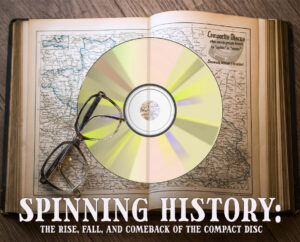
Spinning History: The Rise, Fall, and Comeback of the Compact Disc
Few objects in music history have had a cultural arc as dramatic as the compact disc. Once the futuristic jewel of the hi-fi world, the CD now lives in the curious twilight zone of nostalgia, stubborn utility, and cult-like collector fandom. To understand the compact disc’s story, though, we need to rewind (yes, pun intended) to the formats that came before it.
Before the CD: The Road to Digital Sound
The idea of storing and replaying sound has always been a tale of tinkering. First came wax cylinders in the late 19th century, pioneered by Edison. They were miraculous at the time but clunky, fragile, and impractical. Then the gramophone record emerged, with flat discs that could be mass-produced. Vinyl records—first 78s, then LPs and 45s—ruled the 20th century for decades. They weren’t perfect: surface noise, warping, and limited durability were constant irritations.
Meanwhile, magnetic tape (and later, the cassette) offered portability and recording ability, but at the cost of fidelity. By the 1970s, audiophiles were clamoring for something better: a format that combined vinyl’s quality with cassette’s convenience.
Enter the dream of digital.
The Birth of the Compact Disc
The CD story begins in earnest in the mid-1970s when two tech giants, Philips in the Netherlands and Sony in Japan, started experimenting with digital optical disc systems. Philips had already been working on the LaserDisc for video, while Sony was exploring digital audio recording.
The two companies joined forces in 1979, and by 1982, the first commercial compact disc rolled off the assembly line. The CD’s technical specs became legendary: a 120mm disc holding up to 74 minutes of audio, chosen (so the story goes) because Sony executive Norio Ohga wanted Beethoven’s Ninth Symphony to fit on one disc.
At its core, the CD was a marvel of geeky engineering. Audio was encoded as 16-bit PCM (pulse-code modulation) at a sampling rate of 44.1 kHz. That meant 44,100 snapshots of sound every second, each one 16 bits deep. The data was etched into the disc in a spiral of microscopic pits, read by a laser that never touched the surface. No wear, no hiss, no warping—at least in theory.
CD Mania: From Hi-Fi Status Symbol to Mass Market
The first commercial CD pressed was ABBA’s The Visitors in 1982. Within a few years, CDs became the holy grail for audiophiles. Early players cost as much as a small car, and discs weren’t cheap either, often priced around $20 – 25 each (that’s nearly $70 in today’s money). But people lined up anyway.
By the late 1980s, CD players had dropped in price, cars started including CD decks, and the public was hooked. Record labels realized they could reissue entire back catalogs on CD, charging fans to buy their favorite albums all over again. It was a goldmine.
Some fun stats:
- By 1988, CD sales overtook vinyl.
- By 1991, more CDs were sold than cassette tapes.
- In 2002, global CD sales peaked at 2.45 billion units.
For musicians, CDs were a double-edged sword: pristine fidelity and massive reach, but also the start of the major-label dominance of digital masters. Still, from hair metal to hip hop, everyone wanted their music “on CD.”
Cracks in the Jewel Case: The Decline of the CD
By the late 1990s, the cracks were showing…both literally and figuratively. CDs could scratch, jewel cases shattered if you looked at them funny, and labels started slapping on those infuriating long cardboard boxes.
But the real blow came from the internet. Napster (1999) and peer-to-peer file sharing made digital music free, albeit illegally. Then came the iPod (2001) and iTunes Store (2003), which made buying digital tracks more convenient than juggling plastic discs. By the late 2000s, Spotify and streaming had arrived, rendering the CD nearly obsolete.
Between 2000 and 2010, CD sales plummeted by more than 50%. Record stores closed en masse, and the CD became the butt of jokes. Those spindles of blank discs in everyone’s desk drawer felt like fossils almost overnight.
The CD Renaissance: Shiny Discs Strike Back
And yet… physical media never truly died. Vinyl might have stolen the headlines as the darling of the analog revival with it’s warm sound, ritualistic listening experience, and collectability, but CDs have quietly staged a comeback in recent years.
Why? A few reasons:
- Affordability – While vinyl prices skyrocketed, CDs remained cheap. For $5–10, fans can grab an album in physical form—often with booklets and artwork included.
- Sound Quality – Audiophiles rediscovered that CDs still sound incredible. Unlike compressed MP3s or streaming, CDs offer full 16-bit/44.1kHz resolution without data loss.
- Nostalgia – Just as cassettes had a quirky cult revival, CDs appeal to millennials and Gen Z who grew up burning mix CDs and flipping through giant binders of discs.
- Collectability – Limited edition pressings, deluxe reissues, and Japanese imports have become hot items on Discogs and eBay.
In fact, the RIAA reported that CD sales in the U.S. grew in both 2021 and 2022, the first time in nearly two decades. Artists like Taylor Swift, BTS, and indie bands alike are releasing new albums on CD, often bundled with merch.
Why Musicians Should Care
For working musicians, CDs might not make you rich, but they remain one of the most accessible merch items. They’re cheap to produce, lightweight to ship, and easy to sign at the merch table. Unlike streaming royalties, which often amount to pennies, CDs offer direct revenue.
Plus, they’re physical proof of your music’s existence in a world where so much is ephemeral. A Spotify playlist might vanish overnight, but that shrink-wrapped CD in someone’s glove compartment? That’s a time capsule.
The Circle Spins On
From shiny status symbol to thrift-store fodder, from near-death to unexpected revival, the compact disc has lived many lives in just four decades. It bridged the analog and digital eras, gave us crystal-clear sound (and scratched heartbreak), and now hums along as a beloved underdog.
So next time you dust off that Discman, or flip open a jewel case to admire the liner notes, remember: the humble CD isn’t just a relic. It’s a survivor, and maybe even the comeback kid of music formats.